FLAVERIA BIDENTIS
Family and Genus:- See- COMPOSITAE
Common Name:- Coastal plain yellowtops, Smelter's bush, Yellowtops,
Speedy-weed.
Homotypic Synonyms:- Ethulia bidentis.
Meaning:- Flaveria (L) Yellow, yellowish.
Bidentis (L) With two teeth, having toothed teeth.
General description:- Erect single stemmed annual herb.
Stem:-
1) To 100cm, single, erect or decumbent, branched distally or ± throughout. solid,
finely ribbed. yellowish.
Leaves:-
1) Cauline, decussate, petiolate or sessile, weakly connate to connate-perfoliate.
2) Blade, (often 3-nerved) oblong-ovate to lanceolate or linear,
a) margins, entire, serrate, or spinulose-serrate,
b) surface, glabrous or short-pubescent.
Flowers:-
1) Heads, radiate or discoid, usually in tight or loose aggregations in often flat-
topped) ± corymbiform arrays or glomerules.
2) Involucres, oblong, urceolate, cylindric, or turbinate, 0.5-2 mm diam.
3) Phyllaries, persistent, 2-6(-9) in ± 1 series, linear, concave, or navicula,
subequal.
4) Receptacles, convex, epaleate ("receptacles" of glomerules sometimes setose).
5) Ray florets, 0-1(-2), pistillate, fertile.
a) corollas, yellow or whitish, laminae, inconspicuous
6) Disc florets, 1-15, bisexual, fertile,
a) corollas, yellow,
b) tubes, shorter than to about equaling the funnelform to campanulate throats,
c) lobes, 5, ± deltate.
Fruit:-
1) Cypselae, weakly compressed, narrowly oblanceolate or linear-oblong, usually
10-nerved, glabrous, black.
2) Pappi, usually 0, sometimes persistent, of 2-4 hyaline scales, or coroniform (of
connate scales).
Habitat:- Commonly found in grasslands, open woodlands, and coastal areas,
where it acts as an invasive species in many regions.
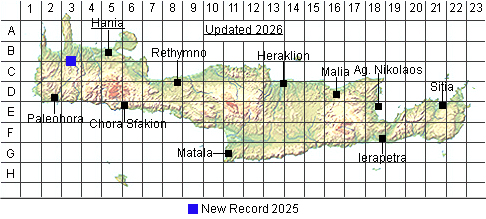
Distribution:- Native to Tropical America. Introduced to Great Britain, Greece, India,
Spain, Sweden, Previously unrecorded from Crete. Discovered by Christopher
Cheiladakis, near Anoskeli west Crete. Sept 2025
Flowering time:- July - Sept
Photos by:- Christopher Cheiladakis
SPECIES DESCRIPTION